Film only what is already visible from a safe position.
The 60-second field guide
Film the repair so the result has something useful to work with.
You do not need a polished video. You need context, a slow approach, the visible edges, and one honest sentence about what changed.
Free repair estimate. Available on iPhone in the US.
- 00–08 SEC
Start wide.
Hold still and show where the problem sits in the room or outside the house.
- 08–20 SEC
Move in slowly.
Walk closer without fast panning or digital zoom. Let the path stay understandable.
- 20–38 SEC
Show the edges.
Pause on nearby seams, trim, joints, stains, cracks, fasteners, and material changes.
- 38–50 SEC
Say what changed.
Describe what you noticed and when. Keep your guess about the cause separate.
- 50–60 SEC
Give it scale.
If it is safe, show a tape measure or an ordinary size reference near the issue.
What to say
Observation first. Diagnosis later.
Your narration is useful context, but it should not turn a guess into a visible fact.
“This crack starts at the top corner of the window. I first noticed it last month. The paint is peeling here. I do not know what caused it.”
- Say where the problem is.
- Say what changed and roughly when.
- Name water, odor, heat, movement, or sound only if you actually observed it.
- Say “I’m not sure” when you are not sure.
- Leave contractor diagnoses and hidden conditions as unconfirmed context.
The camera is not worth a risk
Stop where ordinary observation stops.
A useful estimate should preserve uncertainty. It should never require you to expose, move, climb, energize, or test something unsafe.
Stay off roofs, unstable ladders, wet surfaces, and damaged flooring.
Keep distance from standing water, heat, sparks, smoke, odors, and moving parts.
If the camera cannot see behind a wall or under a finish, that limit belongs in the result.
What clearer footage improves
A more grounded starting point—not false certainty.
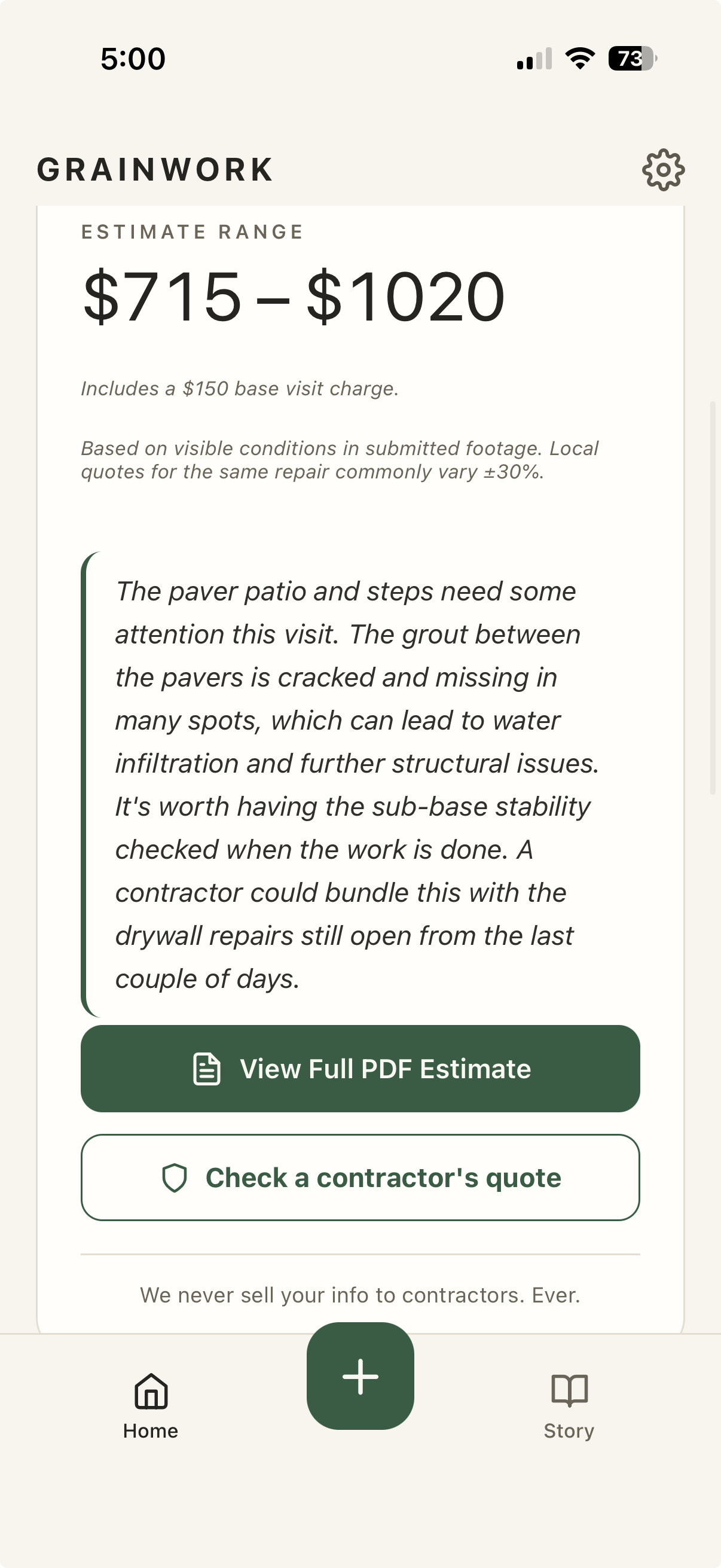
Grainwork turns the visible evidence into a plain-English repair scope and rough cost range, then names what the camera could not confirm.
- More context about where the visible problem begins and ends.
- A better separation between what was seen and what remains unknown.
- A field record you can keep or bring into a contractor conversation.
Have a visible repair now?
The iPhone app accepts a narrated repair video and keeps the result with your house.